
Tag: grief support
-
Why Grief Coaching?
Grief hurts, but that doesn’t mean feeling grief and pain are wrong, despite what so many people may convey to you through words or actions. So often, we put on a mask to hide our true feelings to protect the people closest to us and, even more tragically, to protect ourselves from the people closest…
-
Bright-siding- What is it and How Do You Respond?
If someone has ever come up and said to you, “Well, at least they are not suffering anymore,” or “He/She is in a better place now,” you’ve been bright-sided. For family members who were ill for a long time you might even hear, “Now you can get back to your life.” Bright-sided. Any sentence that…
-
Grief Is a Backpack
When we lose someone we love, it’s like we’re handed a heavy backpack to carry for all the days to come. This is our grief. Over time, we can build the emotional strength to shoulder it more easily, but we never put it down. For some, this may come as an unpleasant shock. After all,…
-
Why Society is Not a Good Example for Processing Grief
I attended the funeral of a high school friend last year and the eulogy was given by a pastor. In his talk, he looked at my friend’s mom and told her she didn’t need to cry anymore- on the day of her son’s funeral as she sat looking at him in his casket. I was…
-
Anger is an Indicator Emotion
According to research, when asked, most people describe three primary emotions: happy, sad, and mad. Our dictionary for what we’re feeling is pretty simple when our emotional reality is actually really complex. Because we don’t have a lot of vocabulary for how we’re feeling, anger can seems like a primary feeling. But anger isn’t usually…
-
Grief Always Finds a Way to be Felt
We can try to medicate our grief in a variety of ways, but that only touches the symptoms. Until we open the door to grief and feel the full weight of our loss, it will continue to find open windows to come through in less healthy ways.
-
Improving your (grief) self-talk

None of us can change the first reaction we have to ourselves, but we can give our more compassionate side a chance to catch up. We do this by pausing, reflecting, and responding.
-
Grief as a series of contractions and expansions
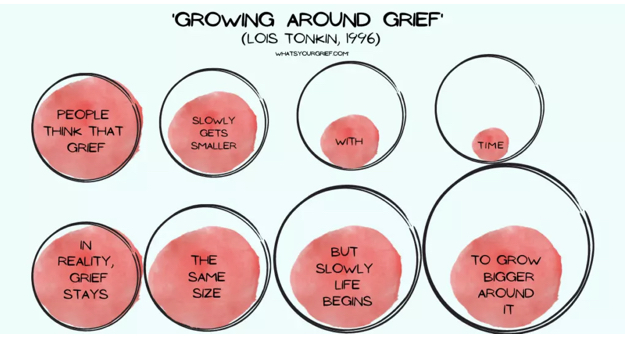
It can be difficult to see the big picture when we’re in grief- one minute we’re doing just fine and in the next, we’re on our knees- metaphorically or literally. It’s easy to wonder if we’re going a little crazy- we may even ask ourselves “why is this happening again?”
-
Your Story Is Sacred- Protect It
Early on in my own grief I couldn’t stop talking about my son. It didn’t matter who they were: friends, family, strangers in the grocery store. They all heard my story. This is a normal response in the acute grief phase- telling our story helps us process what has happened. It helps us to wrap…
-
Writing Your Feelings Helps
There are SO many studies that show writing what you’re feeling can reduce stress, anxiety, & help alleviate depression. This is a practice you do for yourself, so it’s not required that you’re a good writer or even a good speller. Anyone can do it and reap the benefits. All you need is a quiet…
 Lionheart Grief Coaching